“True oceanfront estate” is a phrase that appears on roughly half of Florida's eight-figure listings, which means it has almost stopped carrying information. A serious buyer needs a way to read past it. The most useful frame is the one a buyer's own surveyor and architect would use: read the lot first, the architecture second, and the details third, in that order, because that is the order in which value is either created or can never be recovered.
The lot is the asset
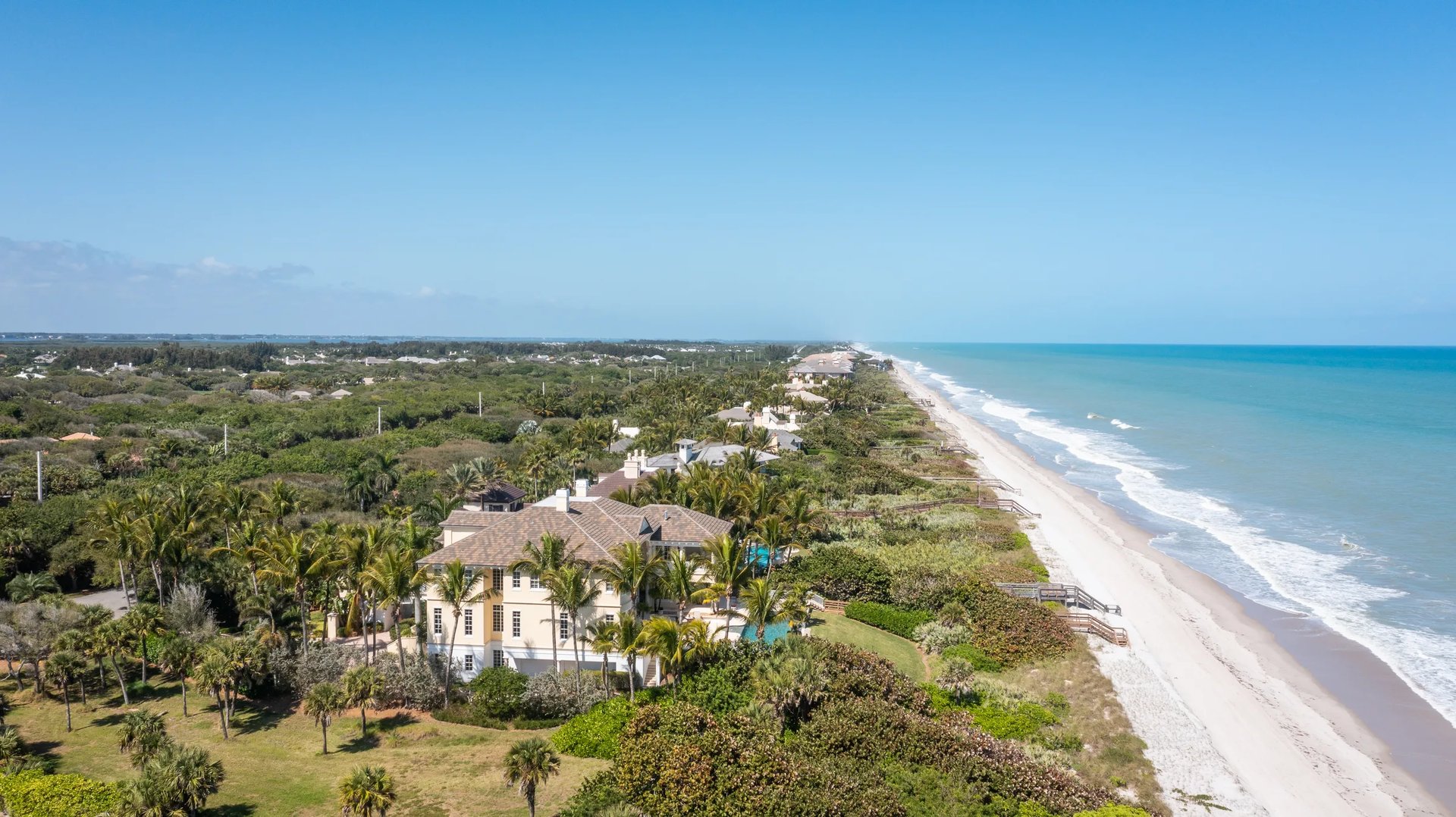
The architecture can be renovated; the lot cannot. On a barrier island, buildable oceanfront ground is genuinely finite: the island is bounded on the east by the Atlantic and on the west by the Indian River Lagoon 1, and only a thin strip in between carries the depth to compose a full residence. That scarcity is why the lot, not the house, is the durable part of the purchase.
Three lot dimensions do most of the work, and none of them appear cleanly on a listing summary:
- Frontage: how much of the shoreline the lot actually owns. This is the number the listing leads with, and the easiest to verify.
- Depth: the distance from the dune line back to the inland boundary. Depth is the quieter, more decisive figure: it determines whether a full pool deck, a dune crossover, and a rear lawn can coexist without competing for the same square footage.
- Orientation: where the lot sits relative to the sun and the prevailing view. South-facing lots hold the long winter light across the living spaces; the difference is felt every afternoon of the season.
Two oceanfront lots on the same stretch of coast can be valued very differently, and the reason is almost always one of these three dimensions rather than the house on top of it. A buyer who can read a lot in these terms understands a property before ever walking inside.
Why architectural coherence matters
The second read is the architecture, not for taste, which is personal and renovable, but for coherence, which is not. A residence built to a disciplined architectural register holds its legibility over decades in a way that a stylistic experiment does not.
On Florida's Atlantic coast the register that has proven most durable is British West Indies: a colonial vocabulary that emerged across the British Caribbean and entered the American luxury market through Palm Beach in the 1920s, credited to the architect Howard Major, who argued the style was a climatically more honest answer to Florida than the Mediterranean Revival then dominant 2. Its elements (deep verandas, hipped roofs, louvered shutters, tall ceilings, columned arcades) began as responses to heat and light, not decoration 3. That functional lineage is why the style reads as coherent rather than costumed, and why a well-executed example remains recognizable as serious work long after a trend-driven house looks dated.
Construction quality belongs in this read too, but as material fact rather than performance promise. What a buyer's contractor confirms is the physical spec (foundation type, the presence of impact-rated glazing, the age and system of the roof), not a story about what any of it protects against.
The details that separate trophy from expensive
The third read is the interior program: whether the house was designed around how oceanfront homes are actually lived in, or simply scaled up. Expensive and considered are not the same thing. The details that mark the difference are consistent:
- The horizon as the organizing element: whether the principal rooms are composed to put a guest's first eye contact on the water, or merely happen to face it.
- Ceiling height and stratification: tall volumes that manage light and air, not just impress on entry.
- A program that separates the way the house is actually used: entertaining volumes distinct from the intimate rooms, the owner's wing distinct from guest quarters.
- Amenities laid out as a plan, not a list. A comprehensive amenity catalog is table stakes at this tier; a plan in which those amenities don't read as a checklist is the harder, more valuable thing.
What to verify before you fall for it
Once the lot, the architecture, and the details hold up, the diligence is ordinary: confirm the survey and the true lot dimensions against the marketing copy, confirm the build era and what the newer-versus-older systems will cost to bring current, and confirm that the address's own rules (municipal, community, or otherwise) match how you intend to live there. None of that is glamorous, and all of it is cheaper to learn before an offer than after.
The general-market companion to this piece, MaxxCity Homes' look at oceanfront-estate architecture, land, and details, covers the same anatomy for the broader Space Coast market; this one is written for the barrier-island trophy tier specifically, where the lot scarcity that drives the whole framework is at its most acute.
“The architecture can be renovated. The lot cannot. Read them in that order.”
If you are evaluating a specific property in these terms and want a second set of eyes on the lot before the house talks you into anything, that is exactly the conversation to have early. We are reachable directly through the brokerage.