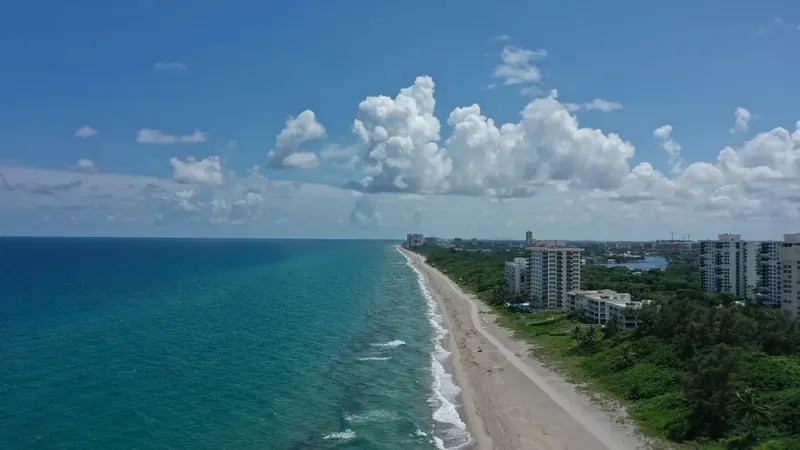
Selling a Florida home while you live somewhere else does not require you to fly down for every signature. Florida law provides two tools built for this situation. A power of attorney lets someone else sign on your behalf, under your direction. Remote online notarization lets a Florida notary registered as an online notary public witness and notarize your signature over live video, from wherever you are 12. Add a closing handled by mail or wire, and most of an out-of-state sale runs without a trip. A few tasks still happen locally, showings and upkeep chief among them, and those need a local plan.
This is written for a seller who already owns a Florida coastal home and lives elsewhere, whether that distance has always been the arrangement or is new because the home was recently inherited. The mechanics below are the same either way; what changes is only how you came to own the property in the first place, not the tools available for selling it from a distance.
This is a description of published Florida law, not legal advice. A power of attorney is a legal document, and whether one is appropriate for your situation, what it should say, and how it should be executed belong with a Florida attorney. Nothing here is drafted for your facts.
Do you need to be in Florida to sign?
No. A Florida notary who is registered with the state as an online notary public may perform an online notarization regardless of whether the person signing, or any witnesses, are physically located in Florida at the time 1. The session runs over real-time, two-way audio-video communication technology, and identity is confirmed through a government-issued credential and an identity-proofing process before the notarization proceeds 2. The result is legally the same notarization it would be in person, conducted remotely instead.
The notarization provider is required to retain an unedited recording of the session for at least ten years 7, which is a longer record than an in-person notarization typically leaves behind. If a question about the signing ever comes up later, that recording is part of what exists to answer it.
Power of attorney: letting someone else sign for you
If you would rather not personally attend any part of the closing, even remotely, a power of attorney lets someone you name, an agent, sign documents on your behalf. Florida does not let a power of attorney work off broad categories. An agent may exercise only the authority specifically granted in the document, plus what is reasonably necessary to give effect to that specific grant, and general provisions that do not identify the authority granted confer nothing 5. A power of attorney intended to sell a Florida home therefore has to spell that authority out rather than gesture at it. To be valid in Florida at all, a power of attorney must be signed by the principal, signed by two subscribing witnesses, and acknowledged by the principal before a notary public 3. Florida law allows, and title companies routinely require, that it be recorded in the county where the property is located 4.
- Does the document specifically identify authority to sell this property, rather than granting a broad category?
- Was it executed with two witnesses and a notary, the formalities Florida requires for a deed?
- Does the title company have the original or a certified copy well before closing, rather than at the table?
- Does this transaction call for it to be recorded in the county where the property sits?
A power of attorney used this way is not an all-or-nothing decision either. Some sellers use it for the closing package only, and still handle the listing agreement, the contract negotiation, and everyday communication personally by phone and email, reserving the agent's authority for the specific documents that would otherwise require a trip. Others prefer to hand off the whole transaction to someone local they trust. Either approach works within the same legal framework; the choice is about what you are comfortable delegating, not about what the law requires.
What if you become unable to sign at all?
A standard power of attorney ends automatically if the person who signed it later becomes incapacitated. A durable power of attorney is built to survive that: it stays effective even if the principal later loses capacity 6. That is precisely the scenario where an out-of-state family most needs someone with existing authority to act, rather than having to petition a court for a guardian mid-transaction.
This is worth deciding deliberately rather than by default. An out-of-state seller who expects to be reachable and capable throughout a sale may not need the durable feature at all; an aging owner arranging their affairs in advance often wants it specifically. Either way, the choice belongs in a conversation with an estate planning attorney before the document is drafted, not as an afterthought once a buyer is already under contract.
The closing itself: mail-away and remote closings
A Florida closing does not require every party to sit at the same table. Documents can be sent to you for wet-ink signature and returned by courier, known as a mail-away closing, or executed through remote online notarization, and funds move by wire rather than in person. Title companies and closing agents in Florida routinely handle both. What changes is the coordination: shipping time if documents travel by mail, or the identity-verification step described above if they are executed by remote notarization.
Which of the two makes more sense usually comes down to preference and timing rather than anything about the transaction itself. A mail-away closing takes longer purely because of shipping, and it means keeping track of an original document en route. A remote online notarization finishes in one session, but it does require a working camera and a reasonably reliable internet connection at the scheduled time. Your closing agent will typically ask which you would rather do once a closing date is set.
A wire transfer at closing deserves its own caution regardless of where you live: confirm wiring instructions by calling your title company directly, using a phone number you already know rather than one from an email, before sending anything. That habit matters for every closing, but it matters more when every other part of the transaction is already happening at a distance and a fraudulent instruction is easier to mistake for a routine one. For the fuller closing sequence, from accepted offer to recorded deed, see What to Expect at Closing.
Getting the house shown and kept up without being there
The part of an out-of-state sale that most often stalls is the property itself: getting it ready, keeping it accessible for showings, and handling anything that comes up between now and closing. A listing agent coordinates showings and access on your behalf, so you are not managing a lockbox from another state, and can point you toward local resources for the physical upkeep a lightly used home needs in the meantime.
You can also see the home the way a buyer does without being in it: professional photography, video, and a walkthrough tour give you the same view of showing feedback and buyer reaction that a local seller gets, and a phone call after each showing covers the rest. None of this requires special equipment on your end, only a listing team set up to communicate that way as a matter of course rather than as an exception made for a distant seller. If the home was recently inherited, our Preparing a Luxury Coastal Home for Sale piece covers what typically needs attention before a coastal home goes on the market.
- Preparing the home for market: cleaning, repairs, and staging, coordinated on your behalf.
- Physical access for showings, inspections, and appraisals.
- Routine upkeep between now and closing.
- The final walkthrough, if one is requested, which a local representative can typically stand in for.
Mail is a smaller detail worth planning for early: forward it, or arrange for someone local to collect it, so a tax notice, an association letter, or a utility bill does not sit unopened for weeks. It is a minor task on its own, but it is the kind of thing that is easy to forget precisely because it is not one of the big, obvious steps in a sale.
Deciding on price and terms without attending every showing
You do not need to be present for every showing, or even most of them, to make an informed decision. A broker who is physically present in the market can prepare a comparative market analysis, relay showing feedback, and negotiate offers on your behalf, with regular calls or written updates covering the rest. A comparative market analysis is a broker's informed opinion of value, and Florida law is explicit that it may not be referred to or construed as an appraisal 8. What actually helps is a clear, agreed cadence for how often you hear from your agent and how offers are presented to you, set at the start of the relationship rather than assumed along the way.
When an offer comes in, the negotiation itself does not require your physical presence either. Terms, price, timing, and any contingencies are typically worked out by phone and in writing, with your agent representing your position throughout, and you make the actual decisions the same way you would if you were sitting across the table.
Time zones are usually the only real friction, and they are worth naming plainly rather than working around silently. If you are several hours removed from the Eastern time zone, agree up front on windows that work for both sides rather than letting every call become a scheduling negotiation of its own.
If the sale involves an estate
Out-of-state heirs selling an inherited Florida home are common enough that it is worth naming directly: everything above still applies, and it typically layers on top of, rather than replaces, whatever probate authority is required. A personal representative living outside Florida can still be appointed and still administer a Florida estate; the tools in this piece are usually exactly the ones that make it practical to do so without repeated trips.
The one sequencing point worth flagging: a power of attorney signed by a personal representative, in that capacity, generally needs the underlying court authority to already exist. If probate has not been opened yet, that is the first step, not something to arrange in parallel with the closing paperwork. Our overview of selling an inherited Florida beach house and our walkthrough of the Florida probate process cover that ground.
“Distance changes the logistics of a Florida sale. It does not change the law, and Florida's law was written with exactly this situation in mind.”
The tools that make this possible are not workarounds. A power of attorney, remote online notarization, and a closing that never requires everyone at one table are built into how Florida real estate already works, for out-of-state owners and Florida residents alike. If you are weighing a Florida sale from out of state, reach out for a listing consultation. Most of what follows, from the valuation conversation to the closing itself, can run by phone, email, and video from wherever you are. For a look at what is currently on the market along the coast, our Stuart guide is a good place to start.
Sources
- Fla. Stat. 117.209: Online notarization authorized
- Fla. Stat. 117.201: Online notarization, definitions
- Fla. Stat. 709.2105: Execution of a power of attorney
- Fla. Stat. 709.2106: Recording of a power of attorney
- Fla. Stat. 709.2201: Power of attorney, general grant of authority
- The Florida Bar, Consumer Pamphlet: Power of Attorney in Florida
- Fla. Stat. 117.245: Recording of an online notarization; ten-year retention
- Fla. Stat. s. 475.612(3): a comparative market analysis or broker price opinion may not be referred to or construed as an appraisal